
My Old School
Mississippi Goshdarn

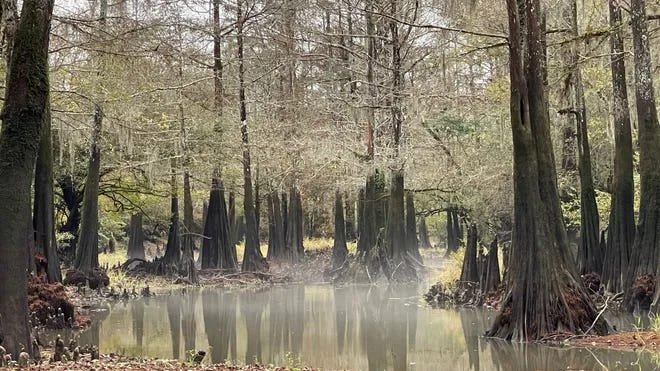
When I was six years old, my family moved from Louisiana to Jayess, Mississippi. Located deep in the backwoods of Lawrence County, Jayess isn’t a town. It’s an “unincorporated community”, basically a post office and a Baptist church, and a road cutting through miles of scraggly wooded fields. It was named in tribute to a local lumber baron, a Mr. Butterfield, who went by the initials J.S. “J.S.”, “Jayess”—get it? It was about a half hour’s drive to the nearest outpost of civilization: Tylertown, home to the public elementary and high school. If you ever get bored enough to ask AI if Tylertown is a good place to live, AI will clear its throat awkwardly and venture that it is “ideal for retirees.”
The Supreme Court had outlawed racial segregation in schools in 1954, well before I was born or my parents even met. When we arrived in Mississippi, 16 years after that decision, the state had finally begun to give up on its strategy of ignoring the law while waiting for it to be repealed. My family had unwittingly parachuted into a rare moment of what passed for social ferment in the area. The white people of Walthall County, Mississippi were whispering to each other, in heated and mournful tones, that the word had come down that this year, the government meant it. People drove down the mile-long gravel drive-way connecting our house to the highway, bearing casseroles and baked goods and, hugging my parents, tried to get them to understand that, up until a few minutes ago, this really had been a wonderful little community.
While my parents and the representatives of their new community conferred and keened together, I had plenty of time to explore my new home and the 500 surrounding acres of fields and trees and swamp and abandoned barns on what had once been a working farm. It was a huge house, with an attic that I was scared shitless of and a fireplace that didn’t work and a brick chimney that bats clustered in during the day. If I needed a really good scare, I could position myself a good ways from the house as dusk settled and watch as the bats came spilling out in a black cloud, squeaking and rustling their wings and heading out to dinner. It felt like I lived in Dracula’s summer place. Most of Sinners is set in 1932, but the pace of change is very slow in Mississippi, and in terms of both the look and overall mood, Ryan Cooler nailed it.
The house, which was built on land that had been in my grandmother’s family forever, burned down in 1985, at which point I suddenly became a little curious about it and asked my grandmother how long it had stood. She thought about it and finally said, “When the Civil War broke out, the men came to collect Ephraim, and he was repairing the chimney. The men said, ‘Ephraim, it’s time to go to the Civil War’, and he said, ‘You go on ahead and I’ll catch up, I promised my wife I would repair the chimney before I leave.’ So, of course the joke around town for years after that was that Ephraim was a day late getting to the Civil War because he had to repair the chimney. Anyway, I don’t know when the house was built, exactly, but we do know that when the Civil War started, it had been here long enough that the chimney needed repairing.” Shelby Foote and Margaret Mitchell rolled into one didn’t have anything on my grandmother.
When the first day of school arrived, my parents, who had been tense and nervous all the previous evening and were clearly aching to talk to me about something, led me out to the front of the house to await the school bus. My mother knelt and hugged me and my father just stood there, radiating manly strength like John Wayne. They warned me that there would be children in the school who were different from me, and that I shouldn’t be alarmed, but if any of them made me uncomfortable or made a menacing gesture in my direction, I should raise my hand and politely ask the teacher to make everything better, in a quiet voice, as if it were a secret. I was warned that these different children would be unaccustomed to straight, blond hair like mine, and they might become transfixed and reach out to touch it, but to just remember to signal the teacher in a calm way. Don’t let them see your fear, that was a major theme of the pep talk. My mother, who was the closest thing we had to the family hipster, gave me some basic street advice. If you do talk to them, she told me, whatever they do to provoke you, just remember not to ever say anything about anybody’s mother.
I don’t know if this is still standard practice anywhere, but at that time, in that place, the first day of school was a half-day getting-acquainted ritual in which we met out teachers and were taken to our classrooms and textbooks were doled out and we were shuttled from one place to the next. We didn't learn shit except for where the bathrooms were. And I think everybody, Black and white, must have gotten a similar lecture to the one I got, because I remember everybody being anxious and touchy and looking frightened, as if all of our little seven-year-old asses were waiting for The Blackboard Jungle to break out. People didn’t say anything to anyone except the friends they had maybe already met before that day.
As the new kid in town who loved way the fuck out in the woods where there weren’t any kids, I didn’t say anything to anybody, until the last couple of minutes of the school day. As the exciting and historic first day of desegregated classrooms at Tylertown High School wound down, the teacher had us all stand up and form two parallel lines facing the door, waiting for the signal that it was time to file out and slowly quietly yeah right walk to the school buses. I looked to my right, and there in the other line was a Black kid whose shoelace was untied. I summoned up all my courage and went, “Pssst.”
He pulled away, looked at in terror, and appeared about to wave for the teacher.
“Your shoelace is untied.” I whispered.
He looked down, appeared very relieved, told me, “Thank you,” and bent down to tie his shoe.
Then the bell rang and we all marched out to the parking lot and I got on my bus and went home. As the bus rolled down that long, long gravel path, I could see my father waiting for us at the end. My father was not some Sheriff Taylor “Gotta be here to greet Opie when he returns home from his big adventure” guy, and when I saw him, I immediately knew what was happening. Someone must have contacted him and told him that I had spoken to one of the kids who was different from me. It felt as if an hour or more passed between the moment I saw him and the moment the bus stopped and I had to get off. And I had nothing to do in that time but contemplate my fate. Oh my gosh, I thought, he’s going to beat me to death right there, so the others on the bus will see it and I can be an example.
But instead, he leaned down so we were face to face and asked me, how would I like it if, instead of going back to that terrible school ever again, I went to a much better school that was being built right that minute and wouldn’t be ready for another few weeks, so I’d have another few weeks of summer vacation? It sounded as if this option came without a beating, so of course I liked it very much. That’s how I became part of the inaugural class of Walthall Academy, a private—i.e, segregation—academy that the town burghers had agreed to erect, open to any white residents willing to pay fantastical sums of money to keep their children’s educational experience racially pure. Segregation academies provided a workaround for such families by giving them an alternative to “public” education that might still be seen by future prospective employers as at least half a step up from home schooling. The physical school wouldn’t be a reality for another year, so we set up shop in a little concrete bunker that was the first thing you saw when you drove into town from our house.
I was starting the second grade, and had a total of two classmates. One of them was Alice, who was the only daughter of the family flower tycoon and assertive and privileged in a cute-tomboy way. The other was Ray, whose family owned the town hamburger stand. Ray stuttered, so for the only time in my life, I had an inside track with the coolest girl in my social circle. I was ill prepared for it. On regular days, Alice would flirt with me by sadistically teasing me, applying Elmer’s glue to her arm, letting it set, then peeling it off and telling me that it was her skin and if there was anything I wanted to say to her I’d better step up and get it said, because she was dying of a wasting disease. On special occasions, she would tell me to meet her behind the building at recess because she had something awesome to show me. I would dutifully arrive behind the building, she would close her eyes and instruct me to kiss her, and I would panic and run back to the front of the building. Then I would feel guilty and worry that when class resumed, she might still be back there with her eyes closed and her lips jutting out, wondering what was the holdup, but she always made her way back in time. We never sat down to discuss my contribution to these interactions, which I was very glad of at the time but might have saved me a few thousand dollars in therapy.
That first year, there were two mature women teachers shepherding the entire student body, with one of them juggling all the younger kids gathered on one side of a dividing wall and the other running the show with the older students. It was probably more hectic than I remember it, but at the time, I didn’t have much in my experience to compare it to. There is one day that impressed upon me that something weird might be going on. There was some big student rebellion spearheaded by Alice; I don’t remember the details, but it involved a dispute between the girls and the boys that spread throughout the building, and when one of the teachers tried to intervene, back talk was committed. The teachers put it down and then, choking back angry tears, they both told us that they should be retired, they had retired, they should be basking in the glow of retirement and the thanks of a grateful nation. But the village overlords had come to them, hat in hand, and described the situation they were dealing with, and they knew they had to come back to the arena and save us precious children. They stopped just short of saying exactly what they were saving us from. You either got it or you didn’t.
Once we settled into Walthall Academy’s permanent home, the place seemed like a normal enough school—again, based on my limited experience of normal. Each day began with everyone standing up and reciting the Pledge of Allegiance and then sitting down, lowering our heads, and praying along with the voice on the loudspeaker. I don’t know how much of that ritual was based in anything that could be called actual religious observance and how much of it was one more way of flaunting the school’s protected status against Supreme Court rulings, and I also suspect that for many of the authority figures responsible for the school’s existence, those felt like two ways of describing the same thing. A few moments do stand out in a way that says, again, yeah that was weird. We had one teacher who owned a comedy record by a white comedian whose shtick consisted of telling corny jokes in an Amos ‘n’ Andy minstrel voice. On afternoons when the teacher didn’t feel like working very hard, he would get out the phonograph and give it a spin, after explaining that it was an educational tool to help us better understand “lower dialects.”
And we did have a class in “Mississippi History.” Because the teacher wasn’t going to eat up the hours playing Skip James records or reading aloud from Sanctuary, an awful lot of time was spent dwelling on the War of Northern Aggression. To the teacher’s credit, he didn’t try to sell us on any list of imagined reasons for the war that did not include the South’s reluctance to abandon the peculiar institution. Instead, he spent what, in my perhaps faulty recollection, felt like days and days stressing that slavery was necessary to the farming economy that was a natural outgrowth of the Southerners’ outstanding natural soil and climate. The North, by contrast, could afford to get on its high horse about slavery because their soil and climate sucked and so they had to eke out a miserable living making bathroom tiles or whatever; if they, too, had been able to grow things, rest assured that slavery would still be practiced today, and in every part of the country. Teacher tended to focus on his favorite parts of the history, the lead-up to the war and the aftermath, when what he called “your scalawags and carpetbags” seized control of the tender maid of the Magnolia State and had their vile way with her. I often blanked out during history lectures in school, because the people doing the lecturing so obviously seemed bored out of their minds, but when this guy got started in on the monsters who mistreated the South in the years following the surrender at Appomattox, his delivery had the kind of juicy relish it had when he was talking about a rival football team whose coaching staff he knew personally and who he would love to see fall under a truck.
Since getting out in the world a little, I have found that people whose backgrounds are not particularly blue collar or Southern-based often assume, as soon as I open my mouth, that I must be one racist son of a bitch. And on more than one occasion, people like this have gotten to me well enough to decide that I am not racist as fuck and have straight-up asked me, in a spirit of legitimate intellectual inquiry, for my origin story: what very dramatic, possibly traumatizing, Afterschool Special-worthy incident broke down the racist philosophy that I obviously must have held since my birth on the wrong side of the Mascon-Dixon line and made me see that, despite every assumption I had ever made, all men are brothers? It’s aggravating as hell, and sometimes, just to get it past us both, I have been known to make something up. “And then the doctor asked if I would like to meet the person whose blood had saved my life after the accident and was now flowing in my veins, and I said yes, and when they drew back the curtain, to my astonishment…”
But the truth is, I don’t remember ever having been racist. I am sure as hell am not trying to recommend the segregation academy model as an ironic means of fostering progressive values, but despite the sneaky stuff I’m describing, it wasn’t just eight hours every weekday of N-word this, N-word that. There wasn’t a lot of overt racial tension and animosity, which is one perhaps unintended consequence of being around only one race of people every second of your goddam life. I know that because there was no diversity in that bunker, I missed out on a lot, but I was spared a few things, too. I did get plenty of it at home. My dad wasn’t just a garden-variety casual racist, he was a Klansman, by which I mean wore the sheet, burned the cross, family tradition, the whole nine yard. And though he constantly spewed the ugliest racist invective you ever heard in your life, he was also stupid and a bully and disrespected and cheated on my mother who had, you know, given birth to me. So it was easy for me to decide very early on that he was not going to be any kind of role model in my life to any degree at all. I felt closer, and saw more to admire, in Morgan Freeman when I watched The Electric Company. I had no idea he was going to turn out to be the great actor of his generation. I could just tell he was smarter than my dad. He made jokes on that show that my dad couldn’t have made. He made jokes on that show that my dad never could have gotten.
Neither he nor the gang at Walthall Academy worked very hard to make sure I saw things their way, probably because, like the Northern liberals I later met who assumed the worst of me, they just thought that I would naturally be what they could only imagine me being—what they could only imagine anyone being, because they saw themselves as the template for normal. As a child, I was always around white racists who saw themselves as Christians and patriotic Americans and who recited the standard boilerplate about looking past people’s skins and appraising them based on the content of their character and we’re all in this together, rakka-rakka-rakka. I never thought of them as hypocrites and sure never imagined that they were masters of conscious or unconscious compartmentalization. I just naively thought they hadn’t thought it all through, and that they would eventually figure it out, hopefully when I wasn’t nearby to hear them shout “D’oh!”
The first time I heard anyone at Walthall Academy invoke the N-word, it was when we were on the playground and J. J. White invoked it to insult me. I said something very grown-up and probably Afterschool Special-ish about how racist insults are too dumb to qualify as successful insults, and you could have knocked me over with a feather when I looked around and realized that nobody had my back. I was always a weird kid, but I had been tolerated by the other kids, even as the classroom populations at Walthall Academy grew bigger, because Alice vouched for me. After that, even she stopped speaking to me, though when she was feeling generous and no one else was watching, she sometimes threw me a pitying look. In the end, the only one who figured anything out was my mom; she threw my dad out of the house when I was thirteen—by which time the ever-increasing tuition fees demanded by the Academy were enough to jump-start the economy of a medium-sized South American country. (I know how important it was to my dad that I go there, but I don’t know how he came up with the money. It would only partially explain it if I came across conclusive proof that he was D. B. Cooper.)
After my dad was out of the picture, I was shuttled off to Tylertown High School, where I was looking forward to finally having friends and having a normal life. But I was still a weird kid, and everyone knew I had gone to Walthall Academy, so most of the Black students hated my guts because they thought I was racist, and most of the white kids hated me because they were jealous. But that’s another story, which I promise I will never tell, even under threat of torture. By the time I graduated and was released into the untamed wilds of Ronald Reagan’s America, I was pretty optimistic about the future of race relations in Walthall County and in my country at large, which set me up for forty years of being reminded that I will never understand what the hell is going on. One thing I do know is that when right-wing tech billionaires and the Republican politicians and faux-journalists and professional shit-stirrers who cater to them hear of students, including possible future employees and perhaps even the fruit of their own loins, who may be less racist than they are comfortable with them being, they are quick to believe that these vulnerable young minds have been warped by woke indoctrination carried out by intellectual terrorists who have taken over the classrooms. I also know that this is horseshit. But I do have some experience of race-based political indoctrination performed under the cover of education.